

Marginated Books
Bruce Peel Special Collections is home to a wide selection of books from the sixteenth, seventeenth, and eighteenth centuries characterized by annotations which offer traces of readers and their interactions with books. These annotations include not only marginal comments and corrections (or “marginalia”), but also book prices, personal ownership marks, evidence of how books were shelved and stored, censorship, ornamentation, and even children’s doodles. Other interesting examples of readers' interactions with books include the re-use of a liturgical music manuscript as a binding for a widely circulated emblem-book (Emblemata, 1567) and a copy of John Bunyan’s The Pilgrim’s Progress (1717) in which the owner, William Wieatt, commemorates the book as a gift from his mother with a poem. Besides revealing readerly interactions, these books are interesting for a broad spectrum of content, from small tabbed atlases to works by learned critics of canonical poets and philosophers.
Getting started: Most student researchers will want to employ a series of keyword searches in the University of Alberta Library catalogue in order to find print and digital materials about marginalia in all U of A library locations and collections, including the Peel library. For more information about research in the Peel library, see Finding and Requesting Peel Library Materials.
Further resources: It is worth noting that it is much easier to find information about marginalia than it is to identify books that are themselves actually marginated, so we owe a tremendous debt of gratitude to professors Sylvia Brown and John Considine for their painstaking research, undertaken to identify and analyze seventeenth- and eighteenth-century marginalia in Peel collections. Their work was showcased when Peel mounted two major exhibitions and published accompanying books/catalogues: The Spacious Margin: Eighteenth-Century Printed Books and the Traces of Their Readers (2012-13) and Marginated: Seventeenth-Century Printed Books and the Traces of Their Readers (2010).
Collection Formats: 16th Century, 17th Century, 18th Century -- click to see other collections with this format
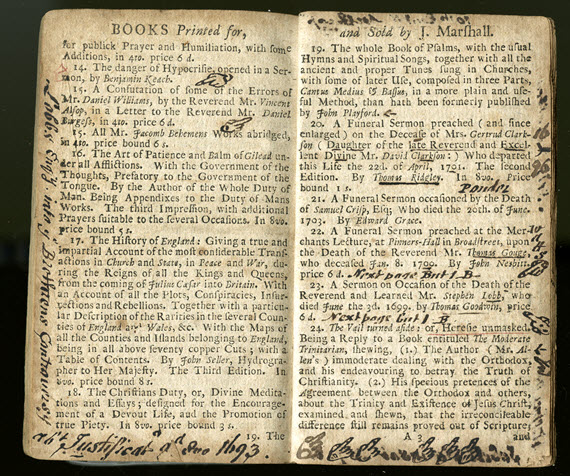
Marginalia in a list of books printed for J. Marshall included in a copy of John Bunyan's The Work of Jesus Christ: As an Advocate, Clearly Explain'd, and Largely Improv'd, for the Benefit of All Believers (PR 3329 W1 1702).
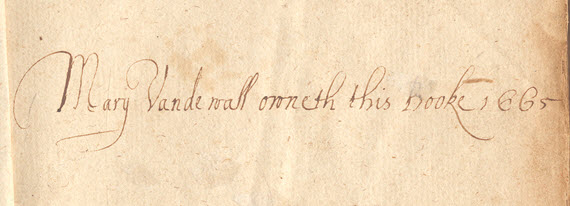
Ownership mark (Mary Vandenall, 1665) in a copy of Samuel Fisher's Rusticus ad Academicos (BX 7730 F53 1660).
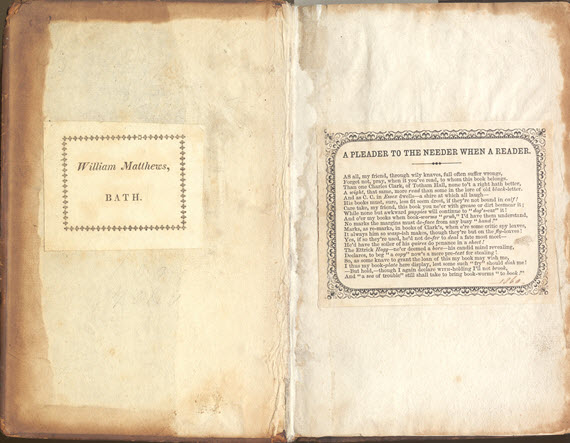
Bookplate for William Matthews in a copy of Mary Astell's Some Reflections Upon Marriage (HQ 731 A85).
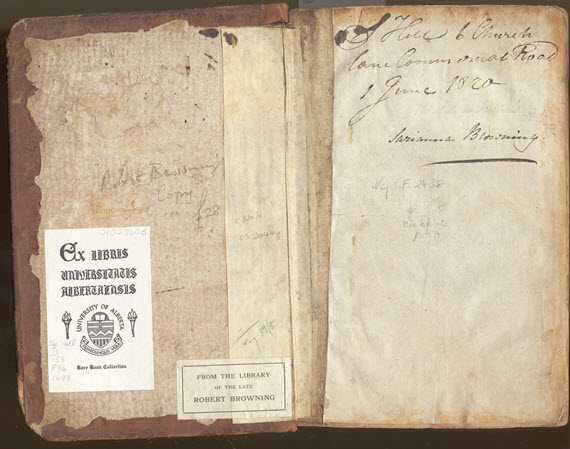
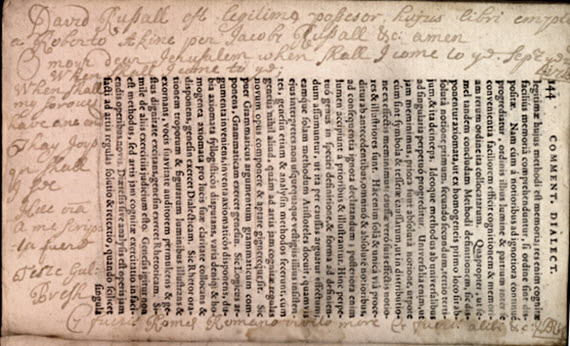
Marginalia perpendicular to the main text on p.144 or Severin Slüter's Anatome logicae Rameae, qua ipsa praecepta primum perspicu dissecantur et explicantur (B 785 R43 S59 1608).